
The F to VES Spelling Rule
The F to VES Spelling Rule
May 07, 2026
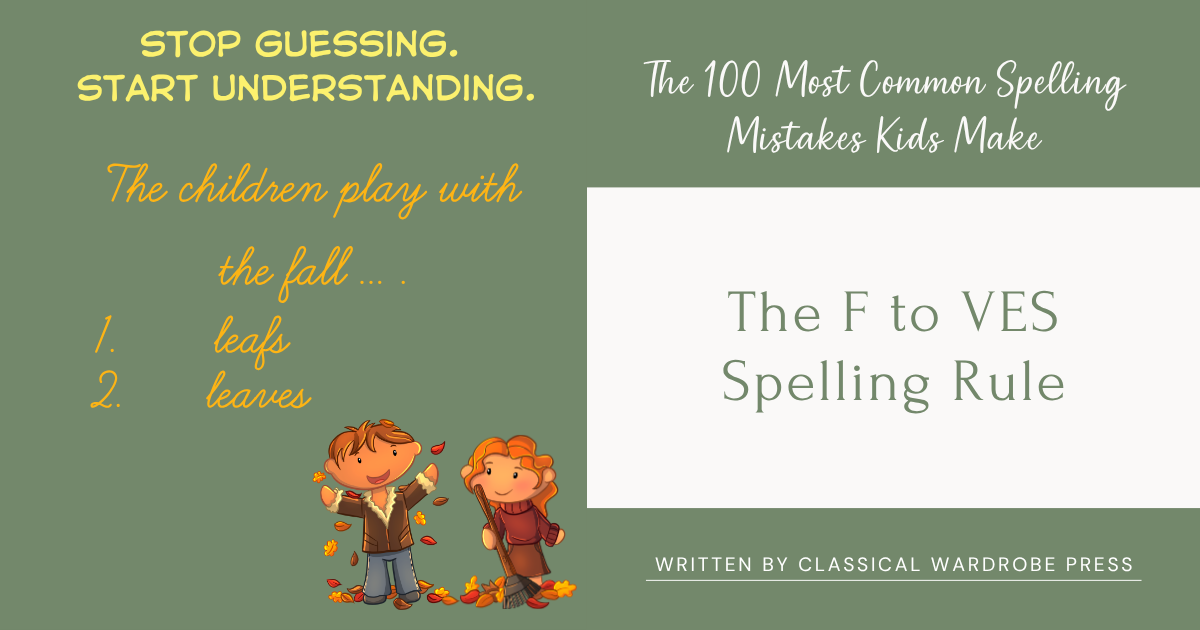
Children often write leafs instead of leaves, or wolfs instead of wolves. These are natural mistakes. They show that the child is applying what they know: most plurals are formed by adding -s.
But English spelling is not based on sound alone. It also reflects patterns shaped by history and word structure. One such pattern is the change from f to ves.
What Is the F to VES Spelling Rule?
Some nouns ending in f or fe change their ending to ves when forming the plural.
For example:
- leaf → leaves
- wolf → wolves
- knife → knives
- wife → wives
- shelf → shelves
Instead of simply adding -s, the spelling changes within the word itself.
- leafs => leaves
This spelling pattern is part of a group of irregular plural nouns found throughout the English language.
Why Does “F” Change to “VES”?
The change from f to v comes from the history of English pronunciation. In older forms of English, the f sound often softened into a v sound when another ending was added to the word. Over time, spelling began to reflect this pronunciation change.
This is why we now write:
- leaf → leaves
- knife → knives
even though the singular form still ends with f or fe.
English spelling often preserves older language patterns, which is why many spelling rules make more sense when we look at word history and structure.
Common Words That Follow the F to VES Rule
Here are some useful examples for children to learn together:
- leaf → leaves
- wolf → wolves
- knife → knives
- life → lives
- wife → wives
- shelf → shelves
Teaching these words as a group helps children recognize the shared spelling pattern more easily.
Words That Do NOT Follow the Rule
Not every word ending in f changes to ves. Some words simply add -s:
- roof → roofs
- belief → beliefs
- chief → chiefs
- chef → chefs
This can seem confusing at first, but it reflects the rich history of the English language. English spelling contains both patterns and exceptions.
Rather than memorizing isolated rules, children benefit from seeing words grouped into meaningful word families. That is why Charlotte Mason highlighted the importance of the child doing transcription before dictations (See our blog post Why Transcription Comes Before Dictation). An incorrect spelling can stick in the memory and create confusion in the future.
How This Rule Connects to Other Spelling Patterns
This spelling pattern builds naturally on other suffix and word-ending rules.
In our previous post on Understanding Suffixes and How They Shape Spelling, we explored how adding endings can change the spelling of a word.
For example:
- hop → hopping
- make → making
- happy → happier
The F to VES Rule follows the same principle. The word changes form when a new ending is added.
This also connects closely to our earlier post on The Consonant + Y Spelling Rule: Why Happy Becomes Happier, where children learn that spelling patterns often depend on the final letters of a word.
Together, these spelling rules help children understand that English words are built from meaningful structures rather than random letter combinations.
A Charlotte Mason Approach to Spelling
Charlotte Mason encouraged children to learn spelling through careful observation, copywork, and meaningful reading rather than endless lists of disconnected words.
When a child repeatedly sees:
- leaf → leaves
- wolf → wolves
the eye gradually becomes familiar with the pattern.
Instead of guessing, the child begins to recognize the correct spelling naturally through attention and repetition. This gentle approach helps spelling grow steadily over time.
You can learn more about Charlotte Mason’s educational philosophy through the official Charlotte Mason Institute and the resources available at Charlotte Mason Institute.
Why Learning Spelling Patterns Matters
When children understand spelling patterns such as the F to VES Rule, they begin to see connections between words.
Instead of memorizing isolated spellings, they develop:
- stronger visual memory
- greater spelling confidence
- a deeper understanding of word structure
Over time, spelling becomes less frustrating and more meaningful.
The English language may contain exceptions, but it is full of patterns waiting to be discovered, one word at a time.