
Irregular Sight Words Explained
Irregular Sight Words Explained
Nov 30, -0001
Spelling is one of the areas of learning that can quietly shape a child’s confidence for years to come. When spelling comes easily, writing feels natural and enjoyable. When it doesn’t, even the most capable child may hesitate to put thoughts on paper. That is why, in this new blog series, we are gently exploring the most common spelling mistakes children make, not to point out faults, but to understand why these mistakes happen and how we can respond wisely.
This blog post accompanies our weekly spelling series on our social media platforms. While each post on social media introduces a common spelling challenge, the blog allows us to explore the topics more slowly and in greater depth, offering explanation, context, and practical guidance for parents and teachers.
In Part One of The 100 Most Common Spelling Mistakes Kids Make we are focusing on spelling mistakes related to sight words, and will begin with one of the most common challenges: irregular sight words.
What Are Irregular Sight Words?
Sight words are words that appear so frequently in English that children must recognize them quickly to read fluently. Many sight words are phonetic and can be sounded out once a child knows basic phonics patterns.
Irregular sight words, however, are different. These are words that:
- Do not follow typical phonics rules
- Cannot be reliably sounded out
- Must be learned visually, as complete words.
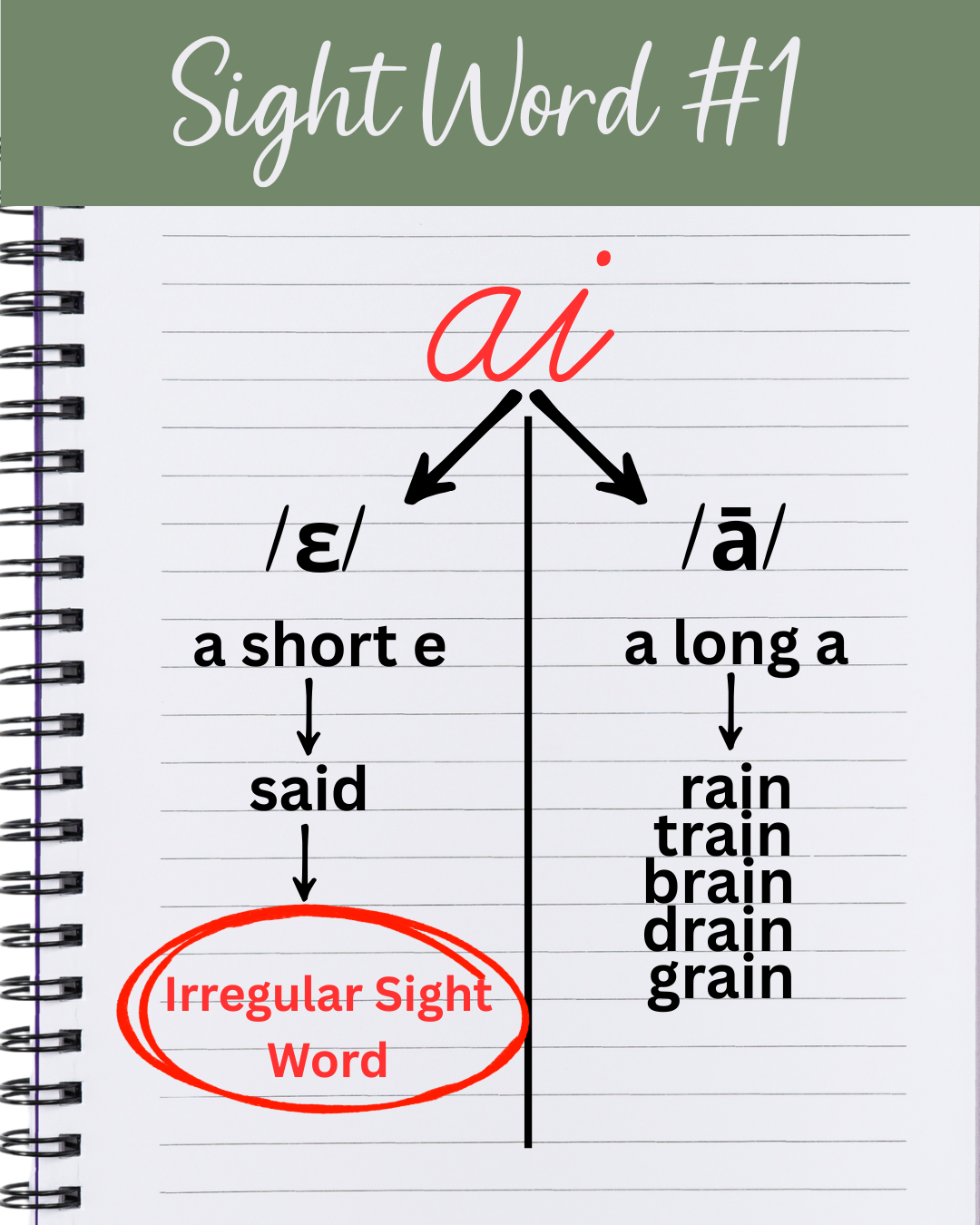
Words such as said, was, one, they, or again often trip children up because the way they look does not match the way they sound. A child who is faithfully applying phonics knowledge may spell said as /sɛd/, which is entirely logical, but still incorrect.
This is not a failure of phonics. It is simply the nature of the English language.
A Charlotte Mason Perspective
Charlotte Mason acknowledged this reality clearly. In Home Education (Vol. 1), she reminds us:
“Many of our English words are, each, a law unto itself; there is nothing for it, but the child must learn to know them by sight.”
(Charlotte Mason, Home Education, Vol. 1, p. 203)
Rather than forcing children to over-analyse these words, Mason advocated for a calm, respectful approach, one that relies on attention, habit, and repeated correct exposure.
This fits beautifully within a classical education framework, where we value accuracy, beauty, and gentle repetition over speed or pressure.
Sight Words Are Not the Enemy of Phonics
One common worry among parents is that teaching sight words will undermine phonics instruction. In reality, the opposite is true when sight words are approached wisely.
Phonics remains the foundation of reading. Sight words, particularly irregular ones, are a small, necessary support that allows children to read real books with fluency and joy while their phonics knowledge is still growing.
The key is balance: we do not replace phonics with memorisation, nor do we pretend English is perfectly phonetic when it is not.
Teaching Irregular Sight Words
Next we look more closely at how to teach irregular sight words gently and effectively, using short lessons, careful attention, and meaningful reading, without drills, pressure, or otherwise overwhelming a child.
When sight words are introduced thoughtfully, they become stepping stones rather than stumbling blocks, helping children read with confidence and pleasure.
Inspired by Charlotte Mason’s method, irregular sight words can be taught simply and effectively using five steps:
- Show the word correctly while you read it aloud
- Let the child repeat the word, this connects sound and meaning without over-explaining
- Let the child copy the word carefully
- Revisit the word briefly over time
- Have the child read connected text.
There is no need for drilling, flashcards used in isolation, or spelling tests that create anxiety. Quiet consistency is enough.
We’ve created a simple printable list of common sight words and irregular sight words that you can use as a reference at home, for free:

Putting Sight Words Into Context
One of the most important principles in spelling, and in all language learning, is context. Words are not meant to live on lists. They live best inside meaningful language.
Charlotte Mason strongly emphasized the use of rich prose and poetry, explaining that children should be immersed in beautiful language from the beginning:
“Little poems suitable to be learned in this way will suggest themselves at once; but perhaps prose is better [...]. Even for their earliest reading lessons, it is unnecessary to put twaddle into the hands of children."
(Charlotte Mason, Home Education, Vol. 1, p. 204)
Poetry and well-written prose naturally reinforce:
- Correct spelling
- Rhythm and rhyme
- Sentence structure
- Vocabulary growth.
The repeated patterns and musical quality of poetry make irregular words far easier to remember.
Why We Use Nursery Rhymes at Classical Wardrobe Press
This philosophy is exactly why, at Classical Wardrobe Press, we intentionally use traditional nursery rhymes, especially those from Mother Goose, in our early literacy resources. These short rhymes have been loved by parents and kids alike for centuries. Our children enjoy singing them and we loved teaching them. They are simply a part of our culture, a reminder of our own childhoods, and a good tradition to pass on.
Nursery rhymes offer:
- Natural repetition
- Predictable rhythm
- Rich vocabulary
- Gentle exposure to irregular sight words in context.
Children encounter tricky words again and again in nursey rhymes, not as isolated spellings to memorise, but as meaningful parts of living language. The rhyme supports memory, the story provides context, and the beauty of the language invites attention.
The irregular sight word said features, for example, in Simple Simon:
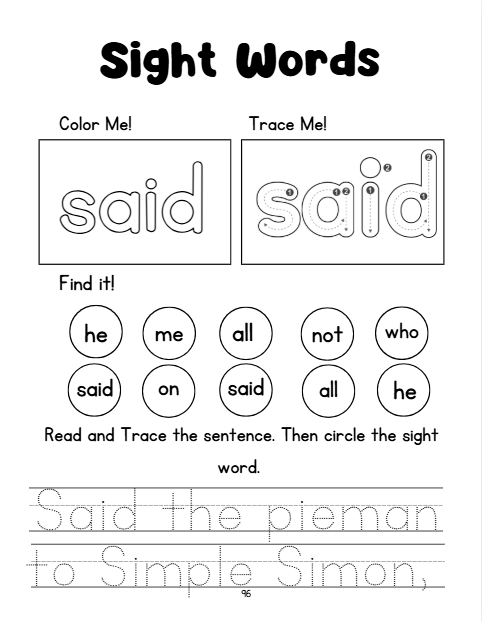
(An extract from from our Sight Words and Phonics workbook for Pre-K and Kindergarten level).
Building Confident Spellers, Gently
Irregular sight words are not obstacles to overcome aggressively. They are invitations to slow down, look carefully, and build good habits from the start.
With:
- plenty of reading
- thoughtful copywork
- beautiful prose and poetry
- and brief, consistent review
children can grow into confident spellers without pressure, frustration, or fear of getting it wrong.
In the next edition of this series, we will look at another common spelling challenge and continue building a calm, classical approach to spelling that truly serves children for life. We hope you will find it interesting and useful.