
Why Do Words End in CK, K, or KE?
Why Do Words End in CK, K, or KE?
Jun 30, 2026
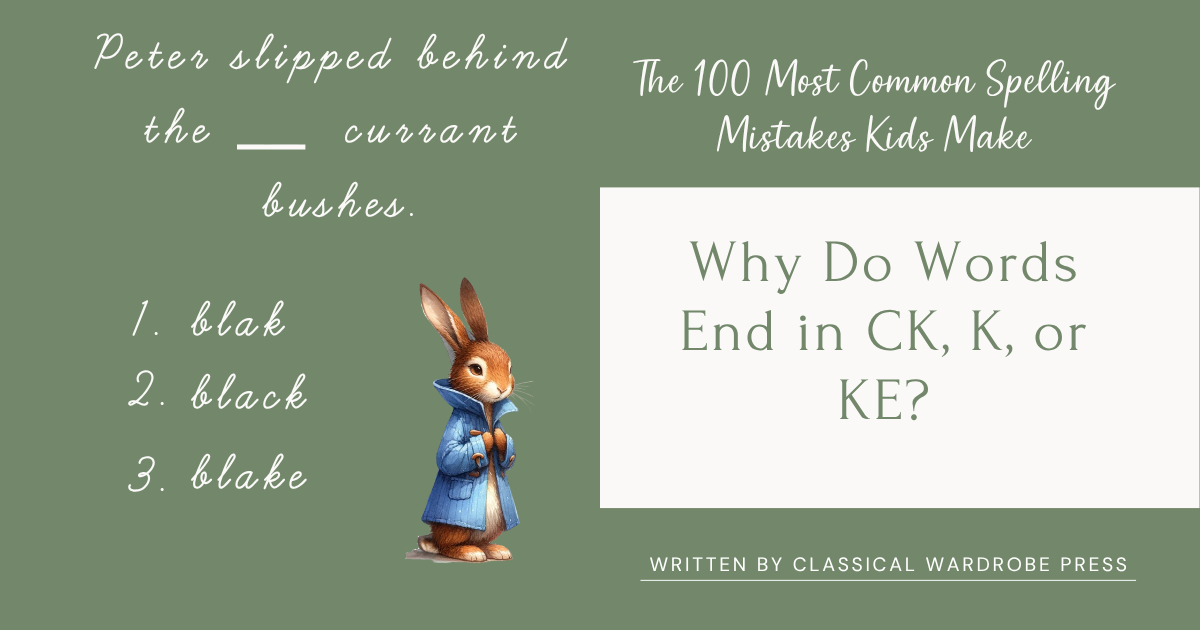
Why Do Words End in CK, K, or KE?
If English spelling always matched pronunciation, words like back, book, and cake might all end the same way. After all, they all finish with the /k/ sound.
Yet English uses three different spellings: ck, k, and ke. Is there a reason?
There is, and once children begin to notice the pattern, many common spelling mistakes become much easier to avoid.
The Three Ways to Spell the /k/ Sound at the End of a Word
English has several ways to spell the final /k/ sound, but the most common are ck, k, and ke. Each follows a pattern rather than being chosen at random.
1. Words Ending in CK
After a short vowel, English often uses ck.
Examples include:
- back
- duck
- neck
- pick
- sock
- rock
- stick
- black
The ck helps signal that the vowel before it is short.
Compare:
- back
- beck
- sick
- lock
In each case, the vowel is short and the word ends with ck.
2. Words Ending in K
Some words end with a single k, especially after another consonant, a long vowel, or certain vowel combinations.
Examples include:
- milk
- silk
- desk
- task
- book
- cook
- look
- week
These words do not need ck because the preceding letters already make the pronunciation clear.
Like many English spelling patterns, there are historical reasons behind these choices, but recognizing the pattern is more important than memorizing individual words.
3. Words Ending in KE
When a word ends with a long vowel followed by the /k/ sound, English often uses ke.
Examples include:
- cake
- make
- bike
- joke
- lake
- snake
- take
Here, the final e is not silent without purpose. It signals that the vowel before it is long.
Without the e, the pronunciation changes:
- tap → tape
- kit → kite
- mad → made
This is the same Magic E pattern we explored in our previous blog post The Magic "e". The e changes the vowel sound while also forming the ending ke.
Seeing the Pattern
Children often confuse these endings because all three produce the same final sound.
A helpful comparison is:

By comparing pairs of words, children begin to notice that spelling reflects the vowel sound as well as the final consonant.
Learning Through Living Language
Rather than asking children to memorize long spelling lists, invite them to discover the pattern through a well-written passage.
For example, while reading The Tale of Peter Rabbit by Beatrix Potter, a child might notice words such as back, duck, or cake.
Pause for a moment and ask:
- What sound do these words end with?
- Which word ends in ck?
- Which ends in ke?
- What do you notice about the vowel before the ending?
Instead of presenting the rule first, allow the child to observe the words and discover the pattern naturally.
This reflects the educational philosophy of Charlotte Mason, who encouraged children to develop the habit of careful observation. Rich literature provides meaningful examples, and discussion helps children recognize patterns that they will remember long after a spelling test has been forgotten.
From Copywork to Dictation: Building Lasting Spelling Habits
Recognizing spelling patterns is only the beginning. The next step is giving children repeated opportunities to notice and reproduce those patterns in meaningful writing.
Charlotte Mason recommended beginning with carefully chosen copywork, see our post Why Transcription Comes Before Dictation, rather than copying isolated words, children transcribe short passages from well-written books, poems, or Scripture. As they write, they learn to look closely at each word, noticing not only its meaning but also its spelling.
Imagine a child copying this sentence from The Tale of Peter Rabbit:
"Peter slipped behind the black currant bushes."
Before writing, encourage the child to pause and observe words such as black. Ask gentle questions:
- Why does black end in ck?
- What sound comes before ck?
- Can you think of another word that follows the same pattern?
This brief moment of observation is often far more valuable than memorizing a list of words ending in ck.
As children become more confident, Charlotte Mason introduced prepared dictation. The child first studies a short passage until its spellings become familiar. Only then does the parent dictate the passage one phrase at a time.
During dictation, the child is not simply recalling individual words from memory. Instead, they begin to recognize familiar spelling patterns naturally. The endings ck, k, and ke gradually become part of their visual memory through repeated encounters in meaningful language.
Over time, this habit of careful observation develops into instinct. Children no longer stop to wonder whether a word should end in ck, k, or ke because they have seen the pattern so often in good literature that the correct spelling simply looks right.
That is one of the great strengths of a Charlotte Mason approach to spelling: children learn not merely to remember words, but to understand them.