
Why Does “PH” Make the F Sound?
Why Does “PH” Make the F Sound?
Jun 09, 2026
Why Does “PH” Make the F Sound?
Why Does Elephant Have a PH?
If English spelling simply followed pronunciation, we might expect to write elefant instead of elephant.
After all, both words sound exactly the same when spoken aloud.
Yet English preserves the letters ph, a spelling choice that reaches back thousands of years to Ancient Greece. What appears to be an unusual spelling is actually a clue to a word's history.
The same pattern appears in many familiar words:
- phone
- phonics
- photograph
- pharmacy
- dolphin
In each case, the letters ph make the same sound as f. So why does English use ph at all? The answer lies in the journey these words took through history. Many entered English from Greek, carrying with them traces of the ancient language from which they came.
Understanding these patterns helps children see that English spelling is not random. Often, a word's spelling tells us something about its origin, meaning, or family of related words.
The Greek Origin of PH
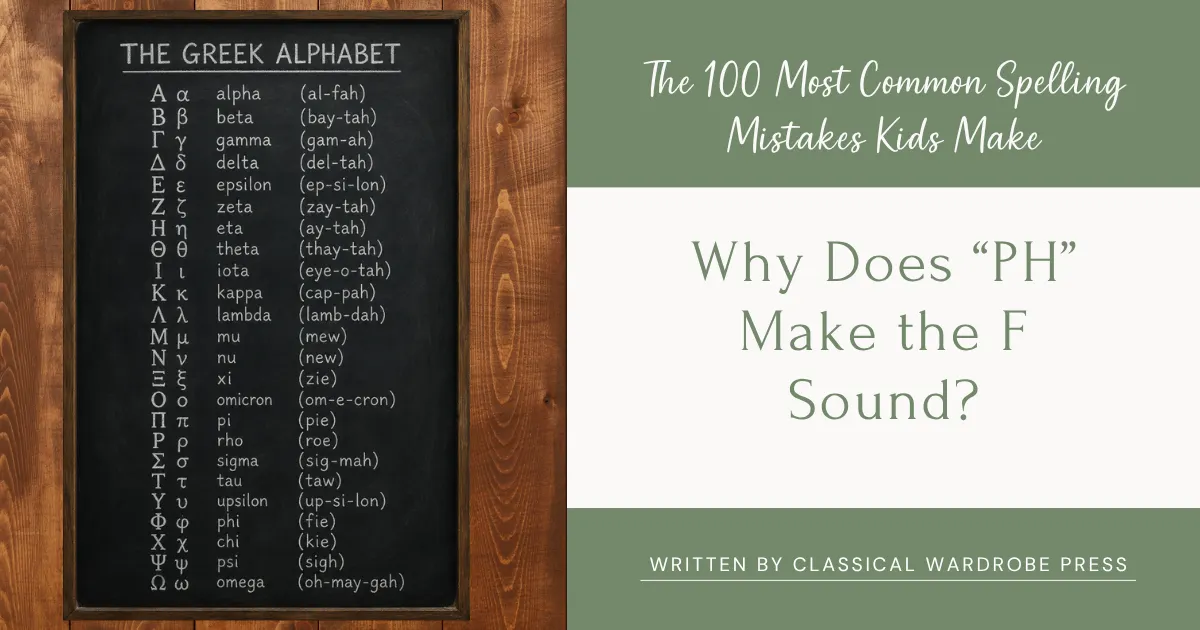
Many English words come from Ancient Greek. In the Greek alphabet, there was a letter called phi (φ). Just as many English words contain Latin prefixes, countless scientific and literary words entered English through Greek.
When Greek words were later written using the Roman alphabet, scholars chose the letters ph to represent this Greek sound. Over time, the pronunciation evolved, and in modern English the combination ph came to sound like our familiar f.
The spelling, however, remained.
This is why we write:
- phone
- phonics
- photograph
- pharmacy
- elephant
- dolphin
Although we hear an f sound, the spelling preserves the Greek heritage of the word.
English spelling often acts like a museum, preserving clues about where words came from long after pronunciation has changed, as we explored in our article on English spelling history mistakes.
A Famous Example: Ophelia
One of the most well-known names containing ph is Ophelia from Shakespeare's Hamlet.
Many children hearing the name for the first time might expect it to be spelled Ofelia. After all, that spelling seems to match the sound.
Yet Shakespeare used the traditional spelling Ophelia, a name with Greek roots. The spelling preserves the word's classical heritage, even though the sound is simply /f/.
This is one reason classical literature can be so valuable in spelling instruction. Children encounter words that reveal connections to history, language, and culture.
A spelling pattern becomes much more memorable when it is attached to a story.
Why Do Some Languages Use PH and Others Use F?
Not every language chose to preserve Greek spellings in the same way.
Languages heavily influenced by Latin scholarship often kept the traditional ph spelling.
French, for example, still uses:
- photographie
- philosophie
- pharmacie
English inherited many of these learned spellings and continues to use them today.
Other languages preferred to simplify the spelling to match the sound.
German commonly writes:
- Fotografie
- Telefon
Similarly, several Scandinavian languages use forms with f rather than ph.
Neither approach is right or wrong. They simply reflect different choices made over centuries as languages evolved.
English generally chose to preserve the historical spelling, while German and many Scandinavian languages preferred a more phonetic approach.
Learning Through Word Families
Rather than memorizing isolated words, children benefit from studying spelling patterns through word families.
For example:
Phone Family (φωνή (phōnē) which means: voice or sound)
- phone
- phonics
- phonograph
- microphone
- telephone
Photo Family (φῶς (phōs)which means: light)
- photograph
- photography
- photographer
As children encounter these words in reading, they begin to notice that ph regularly makes the f sound.
Instead of learning one spelling at a time, they begin to recognize a larger pattern.
This approach builds understanding rather than simple memorization.
Learning Through Living Language
A Charlotte Mason approach encourages children to learn spelling through rich literature, attentive reading, and careful observation.
Rather than beginning with a spelling list, begin with a meaningful text.
A child might encounter Ophelia in Hamlet, a dolphin in a nature study, or a photograph in a biography. The word becomes attached to an idea, a story, or a real experience.
From there, parents can help children observe similar words and discover the pattern for themselves.
Questions such as:
- What letters do these words share?
- What sound does ph make?
- Can you find another word with ph?
encourage children to become active observers of language.
This is often far more effective than memorizing disconnected lists of words.
A Window Into Language History
Words such as elephant, phone, photograph, and Ophelia remind us that English is shaped by many languages and many centuries of history.
The letters ph may seem unusual at first, but they preserve a connection to the classical world and to the Greek origins of many English words.
When children understand these patterns, spelling becomes more than a collection of rules to remember. It becomes a way of discovering the stories hidden inside words.
And sometimes, a simple spelling like ph can open a window onto thousands of years of language history.